
The BSE Sensex plummeted 1,236 points, wiping out nearly Rs 7 lakh crore in investor wealth, driven by escalating tensions between the US and Iran and subsequent market selloff.

The Jnanpith Award conferred upon lyricist Vairamuthu has ignited controversy within the Tamil literary community, with prominent figures like Jeyamohan and Charu Nivedita criticising the decision due to #MeToo allegations and questioning his literary merit.

The Indian government has revised its natural gas allocation priorities, placing LPG production alongside CNG and piped cooking gas at the top, due to disruptions in imported gas supplies caused by the conflict in West Asia.

Indian equity investors experienced a significant loss of 16.32 lakh crore due to a two-day stock market decline fueled by escalating geopolitical tensions involving the US, Israel, and Iran.

Indian stock market benchmarks Sensex and Nifty rebounded strongly after a two-day decline, driven by falling crude oil prices and positive global cues amid hopes of de-escalation in the Middle East.

Platform-style partnerships between global investors and Indian developers are expected to gain further traction over the next few years. This comes as institutional capital increasingly shifts from one-off asset acquisitions to scalable, long-term strategies.

Deepika Padukone has raised concerns about the deteriorating air quality in Mumbai, India, highlighting the impact on residents, especially children. Her comments come amid growing concerns about pollution levels in the city, which have worsened in recent years due to construction, vehicular emissions, and industrial pollution.

Passenger vehicle (PV) sales growth in India is expected to moderate to 3-5 per cent year-on-year (Y-o-Y) in financial year 2027 (FY27) due to a high base and preponed replacement demand, according to a report released by India Ratings and Research on Thursday.

India's industrial production growth remained steady at 4 per cent in September this year due to the good performance of the manufacturing sector, according to official data released on Tuesday. The factory output, measured in terms of the Index of Industrial Production (IIP), had expanded by 3.2 per cent in September 2024.

Indian equities on Dalal Street saw volatility as global market trends and fresh tariff concerns linked to Donald Trump impacted investor sentiment. Track Sensex, Nifty50 movement and key market drivers for Feb 24, 2026.
Equity benchmark indices Sensex and Nifty experienced a significant decline, primarily driven by a selloff in IT stocks due to concerns about AI disruption and renewed worries over global trade.

India's aviation sector is facing fresh turbulence, with rising fuel costs, the Ministry of Civil Aviation's free-seat directive, and geopolitical disruptions in West Asia clouding near-term earnings visibility.

'Our government is committed to addressing it firmly while protecting the rights of genuine citizens.'
Equity benchmark indices Sensex and Nifty rebounded sharply by nearly 1 per cent on Monday, driven by strong buying in power, banking, and financial stocks.

This would imply a 29 per cent year-on-year rise, significantly lower than growth rates seen in recent years.
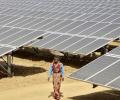
Shares of Waaree Energies and Premier Energies are under pressure after the US imposed initial duties on Indian solar imports. The article examines the impact on green energy stocks and market sentiment.

At the heart of this debate is Section 3(d) of the Patents Act, a safeguard designed to prevent drugmakers from extending monopoly protection through trivial modifications to existing medicines.

India's power demand rose 4.5 per cent year-on-year (Y-o-Y) to 143 billion units (BUs) in January, marking the highest consumption for the month since 2010, primarily on the back of severe cold wave conditions across northern and eastern regions of the country.

The selloff in domestic information technology stocks intensified on Friday, with the Nifty IT index sliding as much as 5.2 per cent during the session before paring losses to close 1.44 per cent lower.
Stock markets closed higher for the second straight session on Tuesday, driven by gains in bank, IT and capital goods shares.

ICICI Bank, Eternal, Titan, Adani Ports, Tata Consultancy Services and UltraTech Cement were also among the laggards. However, InterGlobe Aviation, Tech Mahindra, Hindustan Unilever and Bajaj Finance were among the gainers.

The Indian government reports over 93,000 vacant posts in the Central Armed Police Forces (CAPFs) and Assam Rifles, impacting law enforcement and security capabilities. Recruitment efforts are underway to address the shortfall.
The country's industrial production grew at 4 per cent in August, mainly due to better performance by the mining sector, according to government data released on Monday.

Artificial Intelligence (AI) adoption has led firms to moderate hiring, primarily at the entry-level, according to a report.

The domestic cigarette industry is expected to see a 6-8 per cent volume contraction next fiscal following the imposition of additional excise duties and increase in goods and services tax (GST) rates from February 1, Crisil Ratings said on Wednesday.

'Everybody has stood by Rajpal Yadav. The industry has been supportive.'

'Within six months I expect petrol, diesel, and electric vehicles (EVs) to reach cost parity,' says Union Minister for Road Transport and Highways Nitin Gadkari.

The question is no longer whether the war will expand. It has. The next few days will tell us whether the war stabilises around Hormuz or whether the Strait itself becomes the trigger for a far larger rupture. What to watch for over the next 48 hours is simple: Any move by the US toward direct naval control of the Strait; any credible Iranian attempt to disrupt or mine shipping lanes and, critically, whether energy infrastructure in the Gulf continues to be targeted.If those lines are crossed in tandem, the war will no longer be containable within the region.

'I don't want to do silly or meaningless work anymore.'

Benchmark indices Sensex and Nifty ended marginally higher on Wednesday as a sharp decline in IT blue-chip stocks restricted the rally in the markets.

Indian equities declined on Friday, with the benchmark Nifty posting its worst weekly fall since September, as foreign investor sentiment remained weak amid tepid earnings growth and little progress on the India-US trade front.

The Nifty IT index hit a more than nine-month low, trading at its weakest level since April 17, 2025.
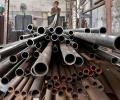
Ahead of the key meeting called by the steel ministry with the industry captains on Monday to discuss the impact of rising steel imports, companies have raised the issue of cheaper 'substandard' inflows from China, Vietnam, and South Korea, saying they are setting the benchmark for domestic prices and squeezing the profitability of Indian producers.

The recent correction suggests that while precious metals hedge geopolitical tension and inflation, they are not immune to sharp short-term corrections and profit-booking.

'A prime hire can have a salary as high as Rs 11 lakh at the entry level and above.'

Alliances fight wars effectively only when they share an endgame. If Israel acted without US knowledge, then the military alliance is operating without real coordination at the level of strategic targeting. Neither picture is reassuring in a war that is no longer regional in its consequences. Prem Panicker continues his must read daily blog on the Gulf War.
Bharat Electronics, Reliance Industries, Mahindra & Mahindra, Larsen & Toubro, InterGlobe Aviation, ICICI Bank and UltraTech Cement were among the other major gainers. Axis Bank, Infosys, Tata Consultancy Services, Trent and Titan were the laggards.

'LIC will reduce but not fully exit its stake in IDBI Bank, which remains an important bancassurance partner,' says LIC of India' MD and CEO R Doraiswamy.

When missiles fly in this region, they are never just aimed at military targets.

New investors should enter gradually and with a long horizon. 'Staggered investment through systematic purchase plans is advisable rather than lump-sum buying.'
